Words for the Way: Musings, Practices, and Reminders from the Mat
nuggets you need to know to support you in your yoga practice and ayurvedic living
shared twice a month
Sunday, November 15, 2026
Hi! Thanks for being here.
Here, in this email, when you could be in a myriad of other places.
Well, I continue to be on my boundary bullshit. This time, energetically versus literally.
A dear friend of mine and I were chatting about energetic boundaries the other day. We talked about the importance of having them, but also about the point at which those boundaries might need to soften.
I believe in boundaries with others to support my energetic health. I can serve no one if I am burning the candle at both ends. Firm, but friendly.
Yet, I can't help but feel that the conversation around boundaries has swung a little too far in one direction. We've gone from having no boundaries to, perhaps, having too many. I think it's okay to be inconvenienced sometimes in pursuit of supporting someone else. If I have something to give, and I have the capacity to give it, why wouldn't I?
The tipping point is different for everyone. It's even different for each of us depending on the season of life we're in, the demands on our energy, and the resources we have available.
I want others to feel connected to me.
To feel supported by me, loved by me, heard by me. I don't want the boundaries I've created to protect my energy to become barriers to connection.
So, where is the balance? At what point does a boundary serve us, and at what point does it begin to separate us?
Perhaps the work isn't in creating firmer boundaries, but in cultivating the discernment to know when to hold them and when to soften them.
I'm curious where you land on this one! Hit reply and tell me: are your boundaries building connection or building walls?
Sending love from afar,
Anna
Sunday, November 1, 2026
Hi! Thanks for being here.
Here, in this email, when you could be in a myriad of other places.
I recently had the incredible pleasure of attending a training on hypermobility. I have to tell you — my mind is blown. This newsletter is a bit on the longer side, but tuck in because it’s worth the read.
Functional range of motion measured by a goniometer is (surprisingly or maybe not surprisingly!) less than what I often see in students while teaching a yoga class. While hypermobility might allow students to more easily access depth in asana, hypermobility is not a super power. It isn’t sustainable.
Overtime, joint laxity can contribute to chronic musculoskeletal pain, fatigue, joint subluxations, and the emergence of multi-system symptoms, such as POTS or digestive disturbances.
Did you know there are certain groups of people who are more susceptible to hypermobility? This includes people who are neurodivergent, those with autoimmune conditions, women, individuals with certain genetic conditions, and young adults.
How to tell if this is you?
You can take the current standard test for hypermobility — the Beighton Scoring System — to get an idea of where you stand on the spectrum. A high score means that your joints are more loose and lax. This in and of itself isn’t necessarily problematic; it’s information. You can use this information to move well within the boundaries of your body.
Let me say that louder… your body has boundaries!!
You can also use this information to best care for yourself if you find your high score exists alongside unexplainable or seemingly unrelated body discomforts, ailments or injuries. The more we know, right?
This new understanding of hypermobility has changed my physical practice immensely. I’ve celebrated props for some time and I’m now using props as scaffolding to support my body in the shapes I make on the mat. The props give me the boundaries that my body doesn’t. These boundaries allow my muscles to engage in each shape, as opposed to bypassing muscle engagement by leaning into the loose joints. It’s a really different physical experience to create boundaries when you’re used to a boundary-less body.
Hypermobility is a really important topic! So important, in fact, that National Geographic wrote an article about it here. (The article is behind a pay wall, but you can access it for free by verifying that you are a human by clicking that link.)
Questions about hypermobility? Want some input on your own body and practice? PLEASE reach out. I’d truly love to talk to you!
Sending love from afar,
Anna
PS: A note for your cute ego (and mine): practicing to support your hypermobile body may mean that the shapes in your body are less deep and “picture perfect.” But hey, I’ll take longevity over Instagram-worthy every single day.
Sunday, October 18, 2026
Hi! Thanks for being here.
Here, in this email, when you could be in a myriad of other places. I’m so glad you’re here because I have some news: You’re going to Italy October 13–19, 2027! How does that sound?
That’s right. My next retreat is taking us to none other than Tuscany, Italy.
The Interest List is officially open! Add your name to be among the first to access enrollment when it opens on October 28th. Read on for all the details!
Italy is calling!
Sending love from afar,
Anna


Sunday, October 4, 2026
Hi! Thanks for being here.
Here, in this email, when you could be in a myriad of other places. I want to invite you to check out my new offering, I Need a Minute, on YouTube.
I Need a Minute offers short practices for when you need to step away from your day and come back to yourself. Each offering is 15 minutes or less, with simple practices in meditation, pranayama, movement, or stillness to help you pause, breathe, and reconnect with your body.
A little backstory: Keith and I will often exclaim to one another, “I need a minute!” when we’re feeling overwhelmed or overstimulated in everyday life. Whoever makes the decree then slinks away to the bedroom or another quiet space to mindlessly scroll on the phone. Five, 10, 15 minutes—yikes, sometimes even longer—pass, and we reemerge feeling no more grounded than when we stepped away.
I Need a Minute is the antidote to that. It’s an opportunity to nourish instead of deplete. To check in instead of check out. The medicine of subtraction—of doing less, of quieting. And it has been deeply healing for me.
I hope you’ll give it a try. And if you know someone else who could use a minute, please share it with them.
New offerings are available every Wednesday.
Sending you love from afar,
Anna
Sunday, September 20, 2026
Hi! Thanks for being here.
Here, in this email, when you could be in a myriad of other places. There have been seasons in my life when I’ve felt deeply disconnected from myself—looking outside of myself for joy, love, and a sense of enoughness. Sometimes I wonder if sharing these things publicly means I’m speaking into the void. But maybe someone needs to hear this.
To you: I see you. You are not lacking. You don’t need to change yourself to fit the expectations of others.
Yoga and Ayurveda have helped me remember this. They’ve taught me that caring for myself isn’t selfish—it’s part of the practice. And there’s something beautiful about the Sanskrit word sneha, which means both oil and love. Snehana, or oleation therapy, uses oil or fat to lubricate and nourish the body. One form of snehana is abhyanga, the practice of self-massage with oil. For me, abhyanga has become one of the simplest and most tangible ways to practice self-love. I practice it 4–5 times a week, and I find it deeply nourishing.
I’ve included a guide below if you’d like to give it a try. Send me a quick reply if you plan to or do — I’d love to hear about it. Take the time to care for yourself. You deserve it.
Sending love from afar,
Anna
Heads Up: Your shower or tub will be slickkkkk after abhyanga. Please warn appropriate parties in your home and/or give the tub a quick clean with vinegar or Dawn. Wishing you loving lubrication.

Tuesday, September 8, 2026
Hi! Thanks for being here.
Here, in this email, when you could be in a myriad of other places. While the official start of autumn is still a few weeks away, perhaps you’re beginning to feel the transition out of summer. Plans are starting to slow down. Days are getting shorter. The air is getting chillier (I wish this were the case for me in Florida!), kids are back in school, etc., etc.
Summer is such a fun time, and yet, I relish the routine and rhythm that settles deep into my being throughout the rest of the year.
The closing of summer feels like a natural time to check in with your own routine. To start, how do you feel when you hear the word routine? Does your armor rise at the thought, favoring instead the spontaneity of life? Or do you feel your body settle, as I do, into the comfort of a framework?
Take a moment to notice what arises with the idea of routine. I understand both responses—and all of the experiences in between.
Consider this: a routine doesn’t have to be rigid. It can be an opportunity. A touchstone each day to check in with yourself.
Through daily routine—dinacharya (dina ~ daily + charya ~ routine)—you develop a baseline understanding of your body. You begin to slow down and notice things about yourself that you might not otherwise.
For example, you may notice how you rested, how much gunk accumulated on your tongue overnight (hmm...what did I eat yesterday?), how your body feels in that particular moment, the level of hydration or dryness in your skin, and so on.
These small observations give you information. They allow you to move through the rest of your day from a place of care and intention, rather than on autopilot or at a constant speed setting.
Dinacharya is an integral part of my day. Some days, I make it through all the steps. Other days, life happens, and I don’t complete the full routine. I find that “life happening” tends to occur more frequently during the summer, which is why this seasonal transition feels like a good time to revisit—or create—your own dinacharya.
Below, you’ll find my dinacharya. Add or subtract whatever makes sense for you. Circle back in a month and edit your routine if you need to. I add in a few steps — like neti and nasya — when the weather cools down. Questions about dinacharya? Feel free to hit reply to this e-mail; I’d love to chat with you about it.
When we see routine as an act of love and self-care, it lands differently.
Sending love from afar,
Anna

Sunday, August 9, 2026
Hi! Thanks for being here.
Here, in this email, when you could be in a myriad of other places. I miss you! Truly—I miss all of my people right now as I build a new community in my new home. Especially on Wednesdays and Sundays. IYKYK.
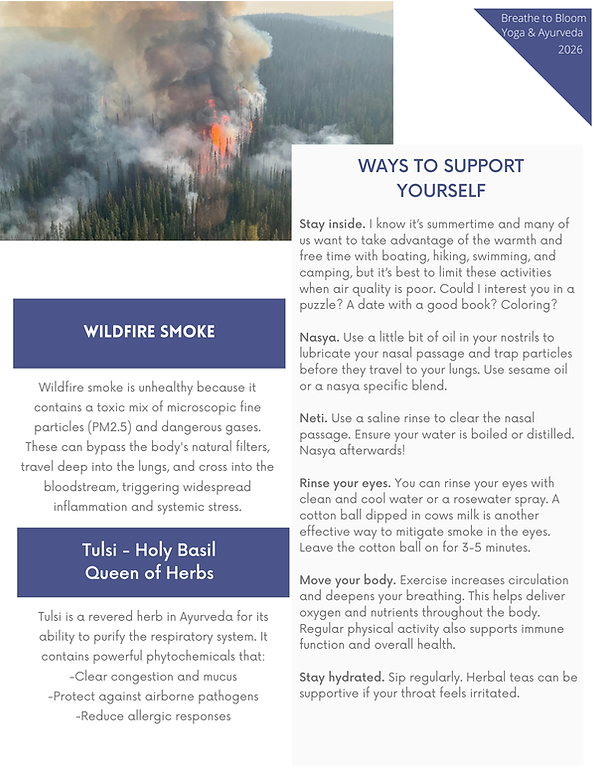
As I sat on my mat today, I found myself wondering how I could still be of service to you, even from afar. My thoughts turned to the wildfires burning and the impact they’re having on air quality for so many of you.
Below, you’ll find a few Ayurvedic ways to care for yourself amidst the smoke and support your body during this challenging time.
If the wildfires aren’t affecting you directly, perhaps you know someone who is. Feel free to share this information with them.
Sending love from afar,
Anna